-
![]()
Joey Albert
Joey has been involved with tech ever since she joined the EaseUS editor team in March 2011 and now she is a senior website editor. She is good at solving various issues, such as video downloading and recording.…Read full bio -
![]()
Alin
Alin is a sophisticated editor for EaseUS in tech blog writing. She is proficient in writing articles related to screen recording, voice changing, and PDF file editing. She also wrote blogs about data recovery, disk partitioning, data backup, etc.…Read full bio -
![]()
Gorilla
Gorilla joined EaseUS in 2022. As a smartphone lover, she stays on top of Android unlocking skills and iOS troubleshooting tips. In addition, she also devotes herself to data recovery and transfer issues.…Read full bio -
![]()
Rel
Rel has always maintained a strong curiosity about the computer field and is committed to the research of the most efficient and practical computer problem solutions.…Read full bio -
![]()
Dawn Tang
Dawn Tang is a seasoned professional with a year-long record of crafting informative Backup & Recovery articles. Currently, she's channeling her expertise into the world of video editing software, embodying adaptability and a passion for mastering new digital domains.…Read full bio -
![]()
Sasha
Sasha is a girl who enjoys researching various electronic products and is dedicated to helping readers solve a wide range of technology-related issues. On EaseUS, she excels at providing readers with concise solutions in audio and video editing.…Read full bio
Page Table of Contents

Jane Zhou
Updated on Mar 19, 2026
0 Views |
0 min read
Starting a faceless YouTube channel is arguably the most scalable way to build a digital presence without ever stepping in front of a camera. Whether you are camera-shy, value your personal privacy, or want to manage multiple YouTube automation channels simultaneously, going anonymous is no longer a hurdle; it's a competitive advantage.
As an anonymous creator, the secret to success lies in high-quality storytelling and professional production value. With the rise of advanced AI video tools and sophisticated voice processing software, the barrier to entry has never been lower. In this guide, I'll share my first-hand experience on how to launch, grow, and monetize a YouTube channel from scratch, all while keeping your identity completely under wraps.
Why Faceless YouTube Channels Are Dominating the Platform
Now, the "Anonymous Creator" model is no longer just a trend; it's a smart business strategy. Here is why creators are ditching the camera:
- Higher Asset Value: Unlike personal brands, a faceless channel is a transferable digital asset. Since the content doesn't rely on your face, the channel is much easier to sell for a high profit later.
- Minimal Overhead: You can skip the expensive 4K cameras, studio lighting, and makeup. Your main investment is just your laptop and your creative tools.
- Global Scalability: It's easy to go international. You can translate your scripts and use different voice-overs to launch the same content in multiple languages, reaching a global audience with half the effort.
- Total Privacy & Freedom: You can maintain a professional persona without sacrificing your personal life. By using voice changer tools, you can even create a consistent, unique brand voice while keeping your identity 100% private.
Step 1. Choose a Profitable Niche for Your Faceless Channel
Not all niches are created equal. The most successful anonymous creators focus on topics where the information or the atmosphere is more important than the person delivering it.
Here are the top-performing faceless niches with high CPM (Cost Per Mile) and massive growth potential:
1. AI & Technology Tutorials
With the explosion of AI tools, everyone is looking for "how-to" guides. You can create screen-recording tutorials for software, automation hacks, or AI art prompts.
Why it works: High advertiser demand means a higher revenue share.
- Tip
- Since these videos are technical, using a clear, authoritative voice is crucial for building trust with your audience.
2. True Crime & Mystery Storytelling
This is one of the most binge-worthy categories on YouTube. By using stock footage and a suspenseful narrative, you can keep viewers hooked until the very end. However, success here depends 100% on the vocal atmosphere. Many creators use voice modulation to deepen their tone or create an "investigative" persona that fits the dark, mysterious theme of the content.
3. Business & Finance Documentaries
Deep dives into corporate failures, success stories (like the rise of Tesla or Apple), or economic breakdowns are highly profitable. These channels attract a high-income demographic, which appeals to premium advertisers.
But remember, focus on data visuals and compelling scripts rather than your personal presence.
4. Health & Psychology Explainers
Topics like "How to overcome procrastination" or "The science of sleep" have evergreen appeal. You can use whiteboard animations or aesthetic B-roll to visualize complex concepts. For this type, a calm, soothing, or "expert-sounding" voiceover can significantly improve your audience retention rates.
Step 2. Master Your Audio and Voice Identity
Since you aren't showing your face, your voice is your brand. This is where most creators struggle; they either hate their natural voice or rely on robotic AI text-to-speech that kills audience retention. I've found that audiences connect far better with real human emotion than with AI voices. However, the challenge is maintaining privacy.
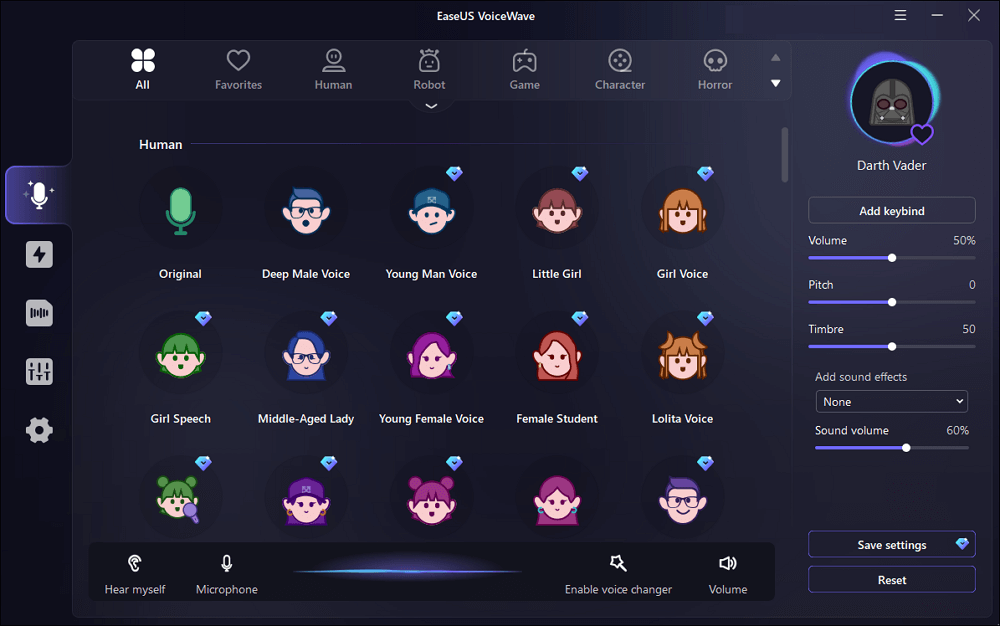
I prefer recording naturally to keep that emotional depth, but I use voice-changing software like EaseUS VoiceWave to mask my identity. This allows you to stay 100% anonymous while creating a consistent, professional "brand voice." By adjusting the pitch and timbre, you can create a unique persona that sounds far more authoritative than a generic AI voice.
Step 3. Assemble Visuals Without a Camera
You don't need expensive gear to tell a compelling story. The visual side of a faceless channel is all about "pacing" and keeping the viewer's brain stimulated.
- Source High-Quality B-Roll: I layer my audio over cinematic stock footage from sites like Pexels or Storyblocks. These visuals provide a professional look without you ever needing to hit the "record" button on a camera.
- Screen Recording for Tutorials: If you are in a technical niche, screen recorders like EaseUS RecExperts are perfect for capturing your process.
- The 5-Second Rule: The goal is to ensure there is a visual change, a zoom, a new clip, or a text overlay every 3-5 seconds. This is the secret to high audience retention in the faceless world.
Step 4. Final Editing and Exporting for YouTube
The final step is bringing it all together. You don't need complex Hollywood software; you need efficiency.
- Choose the Right Editor: I bring everything into CapCut or DaVinci Resolve. These tools are perfect for layering your "branded" audio over your B-roll.
- Syncing and Subtitles: Spend time syncing your background music to the rhythm of your speech. Adding dynamic subtitles is also a great way to keep viewers engaged, especially those watching on mute.
- Keep it Clean: Focus on clarity and flow. A clean, fast-paced edit beats flashy, over-the-top effects every time.
Notice: 3 Common Mistakes to Avoid as a New Faceless Creator
Even with the best tools, many beginners struggle to see growth because they fall into the same traps. If you want to scale faster, make sure you aren't making these three mistakes:
1. Using Robotic AI Text-to-Speech
This is the number one reason for high bounce rates. Viewers can spot a generic AI voice in seconds, and it often feels cold and untrustworthy.
The Fix: To build a loyal audience, you need human emotion and natural inflections. This is why many successful creators choose to record their own voice but use voice changing software to modify it. It gives you the perfect balance: the emotional depth of a human narrator with the 100% privacy of a digital persona.
2. Ignoring the "Click-Through" Factor
New creators often spend 10 hours on the video and only 10 minutes on the thumbnail. On a faceless channel, your thumbnail is your identity. If people don't click, your high-quality content doesn't exist.
The Fix: Use high-contrast imagery and "curiosity gaps." Don't try to explain the whole video in the thumbnail; instead, show a "before and after" or a shocking result that forces them to click.
3. Playing Dangerous with Copyright
Using a 10-second clip of a famous movie or a trending pop song might seem harmless, but it can lead to demonetization or your channel being deleted.
The Fix: Always source your materials from royalty-free libraries. Use Pexels or Pixabay for visuals, and the YouTube Audio Library or Epidemic Sound for background music. It's better to grow slowly and safely than to lose everything to a copyright strike.
Conclusion
Building a faceless YouTube channel is one of the smartest ways to create a scalable digital asset while protecting your privacy. Success isn't about expensive gear; it's about choosing the right niche and mastering a workflow that prioritizes quality and consistency.
As an anonymous creator, your voice is your most powerful tool. By using EaseUS VoiceWave, you can balance professional branding with total anonymity, ensuring your content stays human and engaging. The barrier to entry has never been lower. Pick your niche and start your journey today.
FAQs
1. Do faceless YouTube channels actually make money?
Yes, absolutely. In fact, many faceless channels (known as "YouTube Automation") are more profitable than personality-driven ones because they are easier to scale. Since you don't rely on a specific person, you can run 3 or 4 channels simultaneously. YouTube's monetization is based on the value and originality of your content, not whether you show your face. Using a professional "brand voice" instead of a generic AI voice is often the key to getting approved for monetization.
2. Do I need to buy expensive microphones for my voice-over?
Not necessarily. A mid-range USB microphone or even a modern smartphone in a quiet, carpeted room can produce great results. The key is in the post-processing; using voice modulation software can help clean up your tone and give it a professional "studio" feel.
3. Is it better to use a real human voice or AI text-to-speech?
Human-led audio still performs significantly better in terms of audience retention. Viewers crave emotional connection. If you are worried about privacy, the best strategy is to record your own voice and use a voice changer to create a unique, anonymous persona.
4. Can I manage multiple faceless channels at once?
Absolutely. Because faceless channels rely on a "system" (SOP) rather than a specific personality, they are much easier to scale. Once you master the workflow for one channel, you can easily replicate it across different niches.
5. How much does 1000 views pay on YouTube?
This depends on your RPM (Revenue Per Mille), which varies by niche. On average, you can expect:
- Entertainment/Gaming: $1 – $3 per 1,000 views.
- Tech/Business/Finance: $8 – $20+ per 1,000 views.
Because faceless channels often focus on high-CPM niches like "AI Tutorials" or "Financial Deep Dives," they tend to earn much more per view than a standard daily vlog.